Tires
Repair, Rotation & Replacement
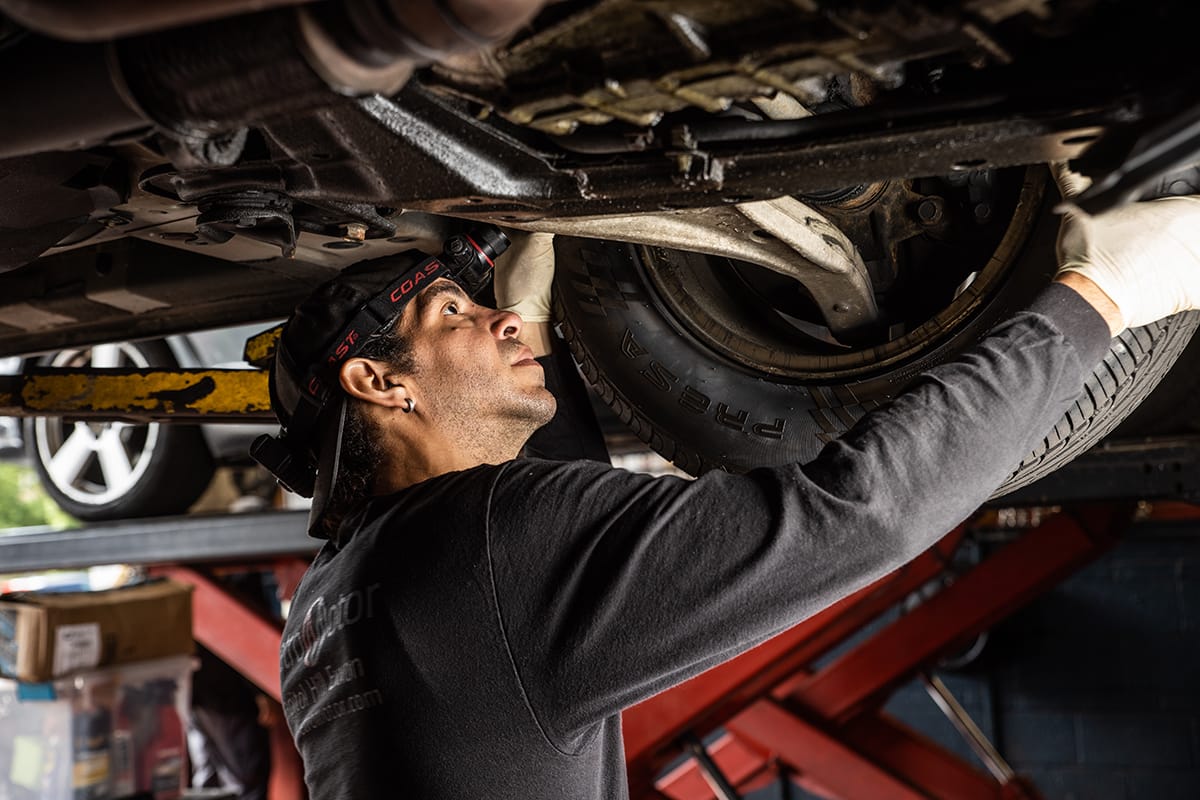
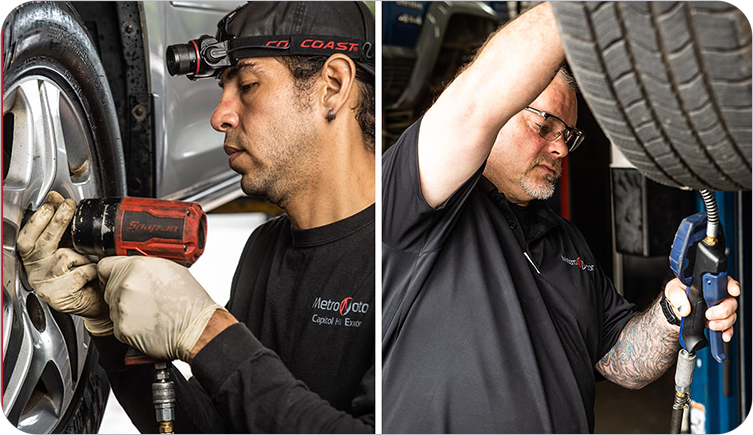
Composite image: Metro Motor auto repair technicians adjust lug nuts and check a tire's air pressure.
Let the good tires roll.
Four patches of rubber, each about the size of your hand. That's the entire connection between your vehicle and the road, and it's doing the work every time you brake, corner, or merge onto the Beltway.
Tires are easy to ignore right up until they aren't. At Metro Motor, our ASE-certified technicians handle the whole range: patching the nail you picked up in a parking garage, rotating a set before the wear gets lopsided, or fitting four new ones when the tread finally runs out. For trusted tire care and repair, there’s nowhere else to be.
The Perks of Tire Care at Metro Motor
Purchase your tires from Metro Motor and receive a suite of complimentary services and support.
Air Top-offs
That’s $1,450 in additional value that’s yours for free, all because you purchased tires from Metro Motor.
Road Tested, Performance Driven
Metro Motor is your source for industry-leading, high-performance tires for all seasons and driving conditions.



Let's make sure your tires are giving you their best.
Well-maintained tires stop shorter, corner better, and stretch a tank of gas further. They also last longer, so you’re replacing them less often.
Every visit to Metro Motor includes a free Preventative Maintenance Inspection. Come in for an oil change and we'll still check your tread depth, your pressures, and how the wear is spread across each tire. If we spot a problem, we'll flag it before it turns expensive. If everything checks out, you’ll hear that, too.
Tire Repair
A nail in your tread isn't automatically a new tire. Our technicians pull the wheel, find the puncture, and check whether it can be patched from the inside, the kind of repair that actually holds up. Punctures in the tread area under a quarter inch across are usually fixable.
Some aren't, and we'll say so. Sidewall damage can't be repaired safely no matter what a roadside plug kit promises, and a tire that's been driven on while flat has usually destroyed its own internal structure even when the outside looks fine. When that's the situation, we'll show you what we're looking at rather than just handing you a number.
Tire Rotation
Front tires work harder. They carry more weight, they do the steering, and on most cars they handle the bulk of the braking, so they wear out well ahead of the rears. Rotating moves each tire to a fresh position and evens out the difference, which is how you end up replacing four tires at once instead of two now and two more in six months.
Every 5,000 to 7,500 miles is the general rule, which lands conveniently close to an oil change for most drivers. The correct rotation pattern isn't the same for every vehicle. Front-wheel drive, all-wheel drive, and directional tires each have their own, and we follow whichever one your manufacturer calls for.
Tire Balancing
A shimmy in the steering wheel at 60 mph usually means a wheel is out of balance. It takes surprisingly little weight difference to produce a shake you can feel, and the vibration doesn't stay put. It works its way into your suspension, your wheel bearings, and the tires themselves.
We balance every tire we mount, and we can rebalance an existing set any time the ride starts feeling rough. It's a quick job with an immediate difference.
Wheel Alignment
Bad alignment quietly destroys good tires. When the angles are off, the tire scrubs sideways as it rolls, shaving one edge of the tread down while the rest still looks close to new. You can lose thousands of miles of tire life this way without ever noticing anything is wrong.
Potholes cause it. So do curb strikes and ordinary suspension wear. If your steering wheel sits off-center, the car drifts on a flat road, or one tire is wearing faster than the others, bring it in. We'll diagnose what's out of spec and get it corrected. And if you're about to put on a new set of tires, an alignment is the cheapest insurance you can buy for them.
TPMS Service
That horseshoe-shaped light on your dash is the tire pressure monitoring system, and it means at least one tire is running low. Every passenger vehicle sold since the 2008 model year has one. The sensors live inside your wheels and run on sealed batteries that give out somewhere around the seven to ten year mark, so on an older car the light sometimes means a sensor died rather than a tire went soft.
We'll work out which it is, replace any sensors that have quit, and reset the system after tire work so the light goes off and stays off.
New Tires & Tire Replacement
We carry a wide selection of tires and we'll help you sort through them without the upsell. The priciest tire on the rack isn't automatically the right one for somebody running errands around the DMV, and we'd rather match the tire to the way you actually drive.
The install covers all of it: old tires off, new ones mounted and balanced, TPMS reset, valve stems replaced, and the old set hauled away and recycled. Add an alignment and your new tires start life pointed in the right direction.
How do you know when it's time for new tires?
Tires rarely fail dramatically. They just get gradually worse until one rainy morning you discover your stopping distance isn't what it used to be. A few things are worth checking yourself between visits.
The Penny Test
Stick a penny into a tread groove with Lincoln's head upside down and facing you. If you can see the top of his head, you're at 2/32 of an inch or less and that tire is finished. Try it again with a quarter: if Washington's head is visible, you're somewhere around 4/32, which is where most manufacturers say to start shopping. Check a few spots around each tire, because wear is almost never even.
Warning Signs
Any of these is worth a look from a technician:
- One edge worn smooth while the rest of the tread looks fine, which usually points to an alignment or inflation problem.
- A shake at speed, or a steady pull to one side.
- Fine cracks running through the sidewall rubber.
- A bulge or blister anywhere on the tire. Stop driving on it.
- One tire that needs air every couple of weeks.
Age & Dry Rot
Tires get old whether you drive them or not. Rubber hardens and cracks over time, and a car that spends its summers parked outside in D.C. ages its tires faster than the odometer would suggest. Most manufacturers put the outer limit around six years, regardless of how much tread is left.
You can date your own tires. The last four digits of the DOT code on the sidewall give you the week and year they were built, so 2823 means the 28th week of 2023. Ask us to check if you'd rather not go squinting at sidewalls in a parking lot.
Roads around the DMV are hard on tires.
Every freeze and thaw cycle opens up a fresh crop of potholes, and a good one can bend a rim, knock your alignment out, or split a sidewall on impact. Add the steel plates over construction, the patches on top of patches, and an expansion joint on every bridge crossing, and an ordinary commute asks more of your tires than the mileage suggests.
Then there's parking. Anyone who parallel parks regularly on Capitol Hill or in Georgetown has scraped a sidewall against a curb, and do it often enough and you wear through the rubber protecting the tire's structure. Road salt in February and baked asphalt in July finish the job. Tires don't get an easy life here, so checking them a little more often is just sensible.
Worn tires are a common reason vehicles fail a Virginia state inspection.
Virginia sets the legal minimum tread depth at 2/32 of an inch, and anything below that is an automatic rejection at your annual safety inspection. Inspectors also look for exposed cords, dry rot, and abnormal wear patterns, any of which can fail a tire that still has plenty of tread left on it.
We'd rather catch that ahead of time than have you find out in the bay. If your sticker is coming up, ask us to look at your tires first. Metro Motor performs Virginia state inspections at select locations.
The right tires depend on how you actually drive.
Tire shopping gets confusing fast, mostly because the options are often sorted by brand instead of by use. Start with what you do with the vehicle and the list gets a lot shorter.
All-Season Tires
What most people around here should be on. All-seasons split the difference between dry grip, wet traction, tread life, and a quiet ride, and they cope fine with the handful of snow days we get. If you drive a sedan or a crossover and your winter plans don't involve I-81, this is your tire.
Winter Tires
The rubber compound stays soft in the cold instead of going stiff, and the tread is cut with fine slits that bite into snow and ice. Below about 45 degrees they beat all-seasons badly, which matters if you commute over the mountains, park on a hill, or simply don't want to think twice during an ice storm. They're a seasonal set, on in late fall and off in spring.
Performance & Summer Tires
If your car came from the factory on summer tires, it came that way for a reason. The grip and steering response are in a different class. The tradeoffs are shorter tread life, a stiffer ride, and poor behavior in the cold, so don't run them through a Mid-Atlantic winter.
Truck & SUV Tires
Bigger vehicles need tires rated to carry the load, and beyond that it comes down to how you use yours. Highway-terrain tires keep a commuting SUV quiet and efficient. All-terrains trade some road noise for toughness off the pavement. Either way, we'll match the load index and speed rating your vehicle calls for.
Why should you choose Metro Motor for tire services?
Plenty of auto repair shops will sell you a set of tires. Here's what's different about ours:
- Certified Technicians: We have ASE-certified professionals trained to work on every make and model.
- Straight Answers: We'll tell you when a tire can be saved instead of sold. Plus, we give free second opinions, always.
- A Free Inspection Every Visit: Every service includes a complimentary Preventative Maintenance Inspection, so tire problems surface early.
- White-Glove Convenience: Drop your car off and take a complimentary Lyft wherever you're headed, or wait it out with a cold drink from the store.
- Flexible Payment: Four tires at once is a real hit to the budget. Our financing options let qualified drivers spread it out.
- Shops Around the Corner: With locations across D.C., Maryland, and Virginia, there's a Metro Motor auto repair facility near you.
These tire questions come up at the counter a lot.
How Often Should I Check Pressure?
Monthly, and always when the weather turns. Pressure drops about one PSI for every ten degrees the temperature falls, which is why half the city's dashboards light up the morning after the first real cold snap. Check when the tires are cold, and go by the sticker inside your driver's door jamb rather than the number molded into the sidewall. That sidewall number is a maximum, not a recommendation.
Do I Need to Replace All Four?
On all-wheel drive, usually yes. Mismatched tread depths make the drivetrain fight itself, and most manufacturers require a full set for that reason. On front- or rear-wheel drive you can often go in pairs, with the new tires mounted on the rear axle for stability. We'll tell you which case you're in.
How Long Should a Set Last?
Most all-seasons are built for somewhere between 40,000 and 70,000 miles, but where you land depends on your alignment, your pressures, and whether the set got rotated on schedule. Rotation is the cheapest way to reach the top of that range.
Can You Repair a Run-Flat?
Sometimes. The rules are tighter and several manufacturers advise against it outright, particularly if the tire ran any distance while deflated. Bring it in and we'll take a look.
Schedule tire service today.
Picked up a nail. Felt a new vibration on the Beltway. Noticed the tread looking thin. Whatever brought you here, schedule an appointment online or stop by your nearest Metro Motor and we'll get it handled.